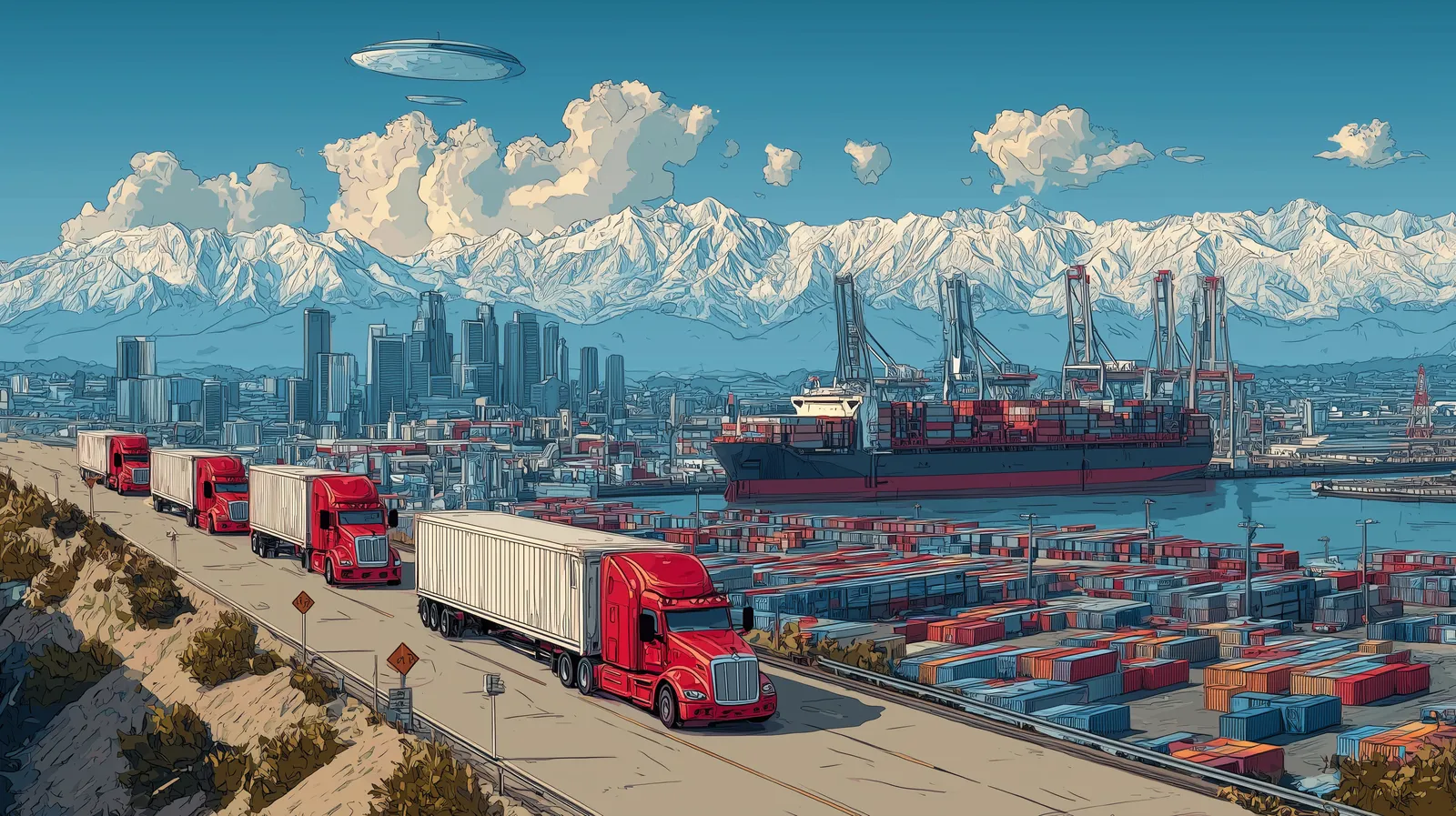
For any transportation manager navigating the I-710 corridor or the bottlenecks of I-35, the frustration is palpable—and perennial. You are moving the lifeblood of the economy, yet the infrastructure you rely on seems designed to actively work against you.
The reality of modern logistics is that despite the critical nature of freight, local policy almost invariably prioritizes the passenger vehicle. While shippers fight for reliability and reduced dwell times, local governments are chasing different metrics entirely.
Shaz Umer, a Senior Transportation Official with deep visibility into these policy dynamics, pinpoints the root of the problem: misaligned incentives.
“Local governments are rewarded for moving people, not goods, and are constrained by congestion in their electoral influence,” Umer explains. “Federal and state transportation programs largely measure success in terms of passenger throughput, VMT reduction, and safety for private vehicles, while freight benefits—reliability, dwell time reduction, and supply-chain resilience—are treated as secondary or external.”
The Infrastructure Reality Check
This “passenger-first” mindset has tangible costs for the supply chain. Shippers operating out of Southern California see this daily. The I-710 corridor carries some of the highest Commercial Motor Vehicle (CMV) volumes in the nation, yet congestion mitigation efforts frequently favor general-purpose capacity or community mitigation over dedicated truck lanes.
According to Umer, freight demand isn’t hitting the road at peak hours because it is optimal for the shipper; it is happening because “port hours, labor rules, land-use constraints, and local ordinances push truck movements into the same windows as passenger travel.”
So, if we cannot build our way out of congestion due to political constraints, how do shipping managers reclaim efficiency?
The L4 Strategic Bypass
The solution may not lie in waiting for new pavement, but in changing how we utilize the existing pavement. Umer argues that the industry’s best bet for breaking the gridlock is a strategic investment in L4 Autonomous Trucking.
By deploying autonomous assets, shippers can decouple freight movement from the biological and regulatory constraints of human drivers. Umer envisions a specific, high-impact application for this technology:
“My proposed solution to increase optimization is to invest into L4 Autonomous Trucking to optimize drayage optimization away from highly congested corridors,” says Umer.
He points to two specific supply chain arteries ripe for this transformation:
The Ports of LA/Long Beach: Using L4 to move drayage out of the port complex more consistently, avoiding the friction of human-centric scheduling.
The Laredo Gateway: Moving freight from the commercial zone at Laredo northbound on I-35 closer to Dallas.
Umer notes that this approach would “streamline intrastate commerce” and subsequently “boost interstate optimization.” For a shipping manager, this translates to a “set it and forget it” lane strategy—using autonomy to bridge the gap between high-congestion ports and distribution hubs, effectively creating a virtual dedicated truck lane where none physically exists.
The Barrier to Entry is Lower Than You Think
For many logistics leaders, the hesitation surrounding L4 autonomy isn’t about the value—it’s about the implementation. There is a lingering fear that autonomous trucks require specialized “smart roads,” V2X sensors, or complex infrastructure overhauls that cash-strapped municipalities will never fund.
However, industry leaders are rapidly debunking this myth.
Daniel Goff, VP of External Affairs at Kodiak AI, a leader in autonomous trucking technology, clarifies that the infrastructure requirements for scaling L4 are surprisingly modest.
“AI-powered autonomous systems generally have the same infrastructure needs as traditional drivers: so clear lane markings and smooth roads,” Goff says.
This is a critical distinction for shippers planning their future networks. You do not need to wait for a government grant to install sensors in the pavement to start benefiting from autonomy.
“We’re not looking for complex V2X solutions or any purpose-built infrastructure,” Goff emphasizes. “What’s good for humans is good for AVs.”
The Takeaway for Shippers
The convergence of Umer’s policy insight and Kodiak AI’s technical reality offers a clear roadmap. We know that public policy will likely continue to favor passenger travel. We also know that we cannot indefinitely absorb the costs of dwell time and congestion.
The introduction of L4 autonomous vehicles offers a way to circumvent the “people-first” infrastructure bias. By leveraging technology that requires no special road upgrades, shippers can create highly optimized, reliable freight corridors—from Laredo to Dallas, or Long Beach to the Inland Empire—that operate independently of the constraints plaguing human-driven fleets.
For the shipping manager, L4 is no longer just a futuristic concept; it is the most viable strategy available to prioritize goods in a world designed for passengers.