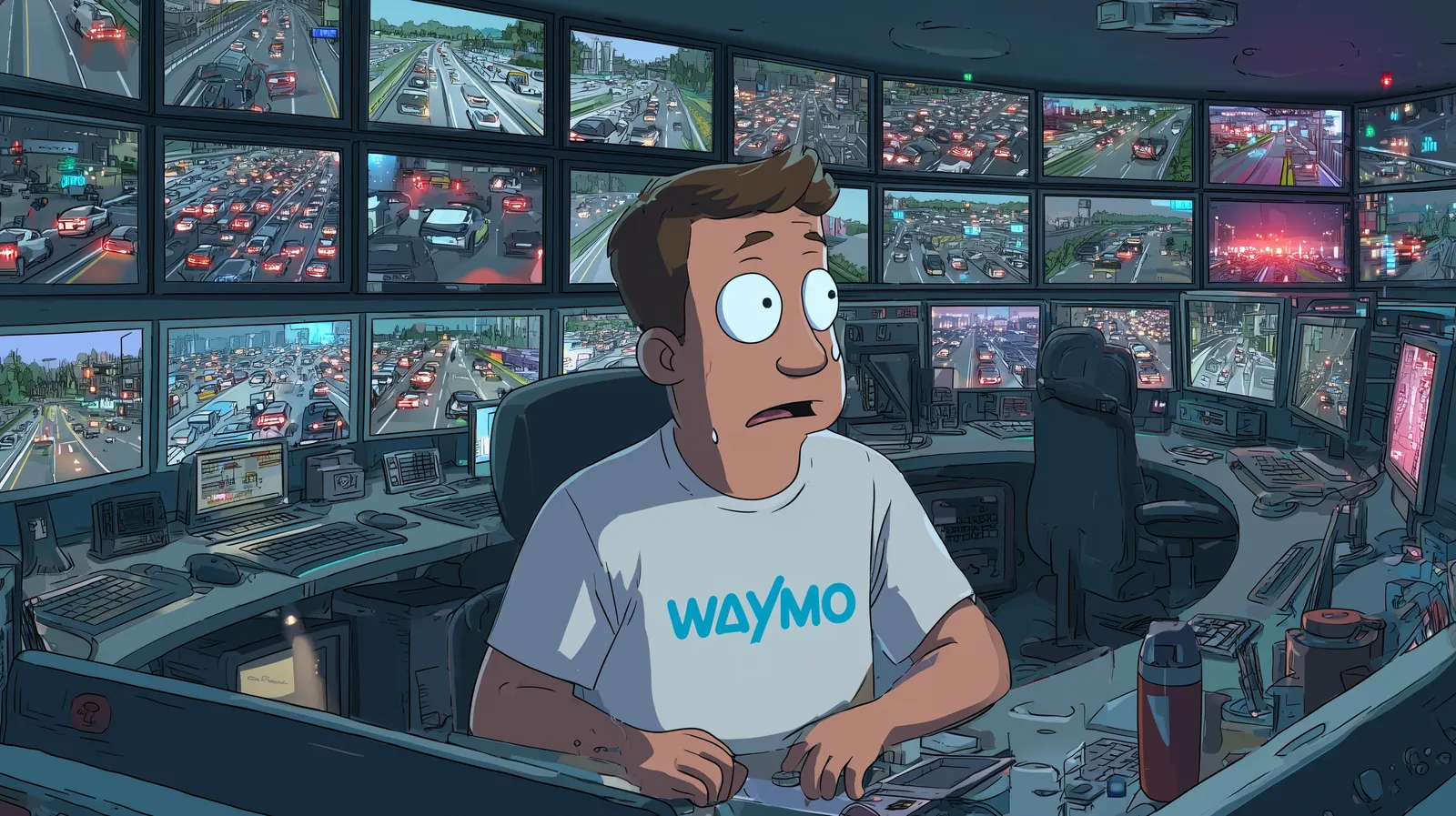
Last week, San Francisco didn’t have a technology problem; it had a scale problem. When a massive power outage plunged the city into darkness, Waymo’s fleet did exactly what it was programmed to do: it defaulted to an “abundance of caution.” For the skeptics, this was a “failure.” But for those of us in the driver’s seat of global supply chains, it was a diagnostic event that revealed the hidden friction points in the future of autonomous movement.
The vehicles didn’t crash, and they didn’t ignore traffic laws. In fact, they successfully navigated over 7,000 dark intersections. The issue was a “Confirmation Spike.” Each time a car hit a dead signal, it paused to ask home base: “Is this okay?” When hundreds of cars asked that simultaneously, the system didn’t just slow down—it hit a data-entry backlog.
For the transportation manager, this reveals a “Decisiveness Deficit.” As we transition from pilot programs to full-scale autonomous corridors, we need to look past the hardware and look at the logic. Here are the three layers of the “Decisiveness Deficit” every shipper needs to understand.
Local Edge Intelligence vs. Cloud Tethering
The SF outage exposed a critical vulnerability: the Remote Operator Bottleneck. Many autonomous systems today rely on a hybrid architecture where the vehicle handles the driving, but a human in a remote “mission control” handles the exceptions. In a vacuum, this is the gold standard for safety. In a regional crisis, it’s a single point of failure.
For a 3PL or a fleet manager, the hidden truth is that many “Level 4” systems are still psychologically tethered to a human “Go” button. If your autonomous truck stops at every downed power line or unmapped construction zone to wait for a human “OK,” your lead-time reliability is at the mercy of a call center’s bandwidth. The next generation of freight efficiency requires vehicles that can interpret a four-way stop with Local Edge Intelligence—making the call on the spot without needing to “phone home” for permission.
Regional Context Awareness: Beyond the Bumper
Currently, most autonomous vehicles operate in a “bubble.” They are masters of their immediate 300-meter surroundings, reacting to the car in front and the light above. But during the SF blackout, these cars were “blind” to the bigger picture. Every dead traffic light was treated as a fresh, isolated emergency rather than a symptom of a city-wide outage.
The incredible value here for supply chain executives is the realization that fleet-wide context is just as important as individual sensor data. If a fleet knows—via a regional data push—that a 10-block radius is without power, the software can shift its “confidence threshold.” Instead of stopping and questioning every intersection, the fleet can switch to an “Outage Protocol” that expects dark signals. Without this regional awareness, you don’t have a fleet; you have a collection of high-tech islands that will inevitably clog your hubs during any infrastructure hiccup.
The Human-to-Robot Ratio: The Scalability Trap
The most overlooked metric in autonomous logistics is the m:N ratio—the number of humans required to monitor a fleet of robots. In normal operations, one human might manage 50 trucks. But the SF outage proved that in an “edge case” event, that ratio can instantly collapse to 1:1.
When 100% of your fleet hits the same obstacle at once, your “Fleet Support” becomes a graveyard of pending requests. For a transportation manager, this is a scalability trap. If your provider’s business model relies on “Remote Intervention” to handle the messy reality of urban or port environments, they haven’t actually solved the labor problem; they’ve just moved it from the cab to a cubicle. Real efficiency in 2026 will be defined by “Decisiveness at Scale”—the ability of the system to maintain its flow even when the human-in-the-loop is overwhelmed.
The lesson from San Francisco isn’t that the robots aren’t ready; it’s that our expectations of their “independence” need to catch up to our operational demands. We don’t need robots that are “smarter” than humans; we need robots that are more decisive when the infrastructure disappears.
As Waymo rolls out software patches to provide “regional context,” the rest of the industry is officially on notice. For the shippers and managers building the next decade of freight, the question isn’t just “Is it safe?” but “Can it make a decision when the lights go out?”