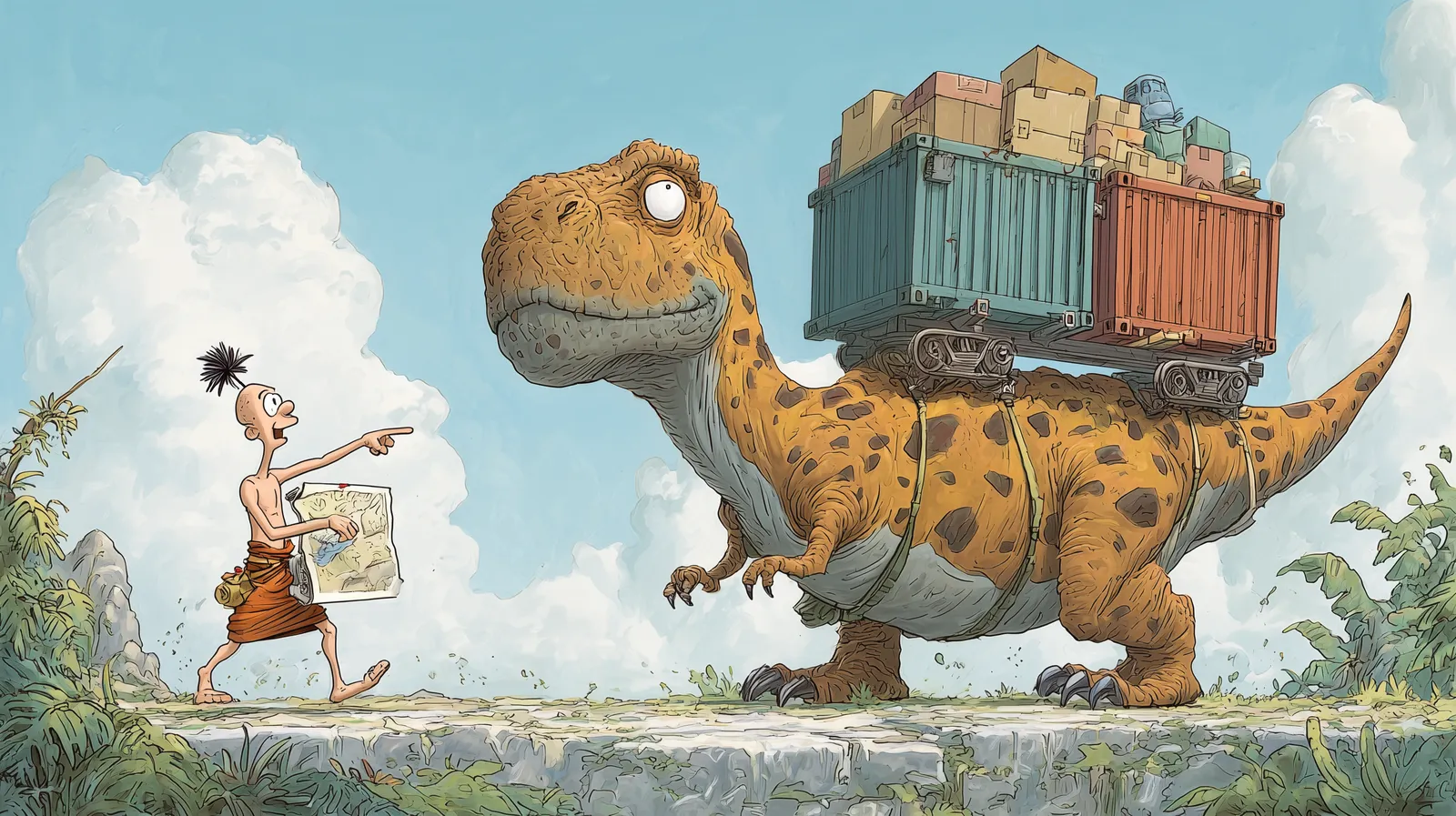
In 2026, the gap between the industry’s leaders and its “dinosaurs” is no longer measured by fleet size or revenue—it is measured by concurrency.
While legacy systems are still trying to bridge the gap between “planning” and “execution” through fragile integrations, a new breed of supply chain orchestration is turning volatility into a competitive advantage. For those managing complex freight networks, the era of checking a spreadsheet to see how a border delay impacts a delivery is over.
From Static Handoffs to Living Orchestration
For decades, the standard operating procedure was the “point-to-point handshake.” A demand planner would create a forecast and “throw it over the wall” to the supply team, who would eventually pass it to the transportation manager. In a stable world, this worked. In 2026—a year defined by near-instantaneous tariff shifts, USMCA reviews, and Laredo capacity crunches—this method is a liability.
The “Dinosaur” trap is the belief that Integration is the solution. But integration is just a pipe between two silos; the data still has to travel, and the plan still has to “refresh.” The modern standard is Concurrency. When every node in the network operates on a single, AI-infused platform, there is no “update” time. If a tariff hits a specific SKU, the transportation load plan doesn’t just react; it evolves simultaneously.
The 2026 Toolkit: Three Paths to Network Equilibrium Navigating this shift requires more than just “better software”; it requires a platform that matches your specific operational DNA. Here is how the three frontrunners in the space—Kinaxis, Blue Yonder, and o9 Solutions—are redefining the standard for 2026.
1. Kinaxis: The Master of “Maestro” Concurrency
The Core Philosophy: Speed and Synchronicity. Kinaxis has moved beyond traditional planning with its Maestro platform. Their focus is on “Supply Chain Orchestration,” which eliminates the lag between a change in the market and a change in the truck route.
The Ideal Use Case: High-volatility environments where the “Plan” changes daily. If you are dealing with sudden Tariff Response needs or shifting border regulations, Kinaxis allows for a “21-day time to value” deployment.
The Ideal User: The COO or Transportation Director who needs to run “What-If” scenarios instantly. It is for the organization that can’t afford a 48-hour delay in decision-making when a port strike or a border blockade occurs.
The Value Prop: Concurrency. When your sales team adds an order, your logistics plan and inventory levels reflect it in seconds, not hours.
2. Blue Yonder: The “Composable Journey” Specialist
The Core Philosophy: Scalable Resilience through Microservices. Blue Yonder’s strength lies in its Data Cloud and its “Cognitive” approach. They emphasize that supply chain reinvention doesn’t have to be a “monolithic cliff event” where you replace everything at once.
The Ideal Use Case: Large-scale enterprises with massive legacy technical debt. Their Composable Journeys allow a shipper to add specific AI microservices—like “Transport Planning” or “Rate Management”—on top of existing systems.
The Ideal User: The IT-heavy logistics leader who wants a “Single Source of Truth” without ripping out their entire ERP. It’s for those who want to leverage a 20x reduction in cost by running queries natively on a data cloud (like Snowflake).
The Value Prop: Interoperability. They offer 3,000+ APIs to ensure that “end-to-end visibility” isn’t just a buzzword, but a functional reality across disparate systems.
3. o9 Solutions: The “Digital Brain” for Multi-Tier Risk
The Core Philosophy: Knowledge-Powered Decision Making. o9 Solutions focuses on building a Digital Supply Chain Twin that doesn’t just look at your trucks, but looks at the entire “Value Chain,” including Tier-2 and Tier-3 suppliers.
The Ideal Use Case: Complex, “Configure-to-Order” businesses where lead times are long and risks are hidden deep in the supply tiers. Their Multi-Tier Risk Management is designed to identify geopolitical risks and “Narco-blockade” style disruptions before they hit your Tier-1 partners.
The Ideal User: The Strategic Planner who wants to replace fragmented Excel-based workflows with a unified “Knowledge Graph.”
The Value Prop: Digital Intelligence. It transforms the “Order Book” into a revenue plan, considering everything from leasing contract durations to the sustainability impact of every shipment.
Conclusion: Selecting Your Strategic Edge
Choosing between these three isn’t about finding the “best” software; it’s about choosing your primary weapon for 2026:
Choose Kinaxis if your biggest threat is Time (you need to react to tariffs and market shifts instantly).
Choose Blue Yonder if your biggest threat is Silos (you need to connect a massive, fragmented global footprint).
Choose o9 Solutions if your biggest threat is Complexity (you need to see three levels deep into your supply network to ensure stability).
The Logistics Roundtable Freight Efficiency Group remains committed to highlighting these shifts. The goal is no longer just moving freight—it’s achieving Network Equilibrium in a world that refuses to stand still.