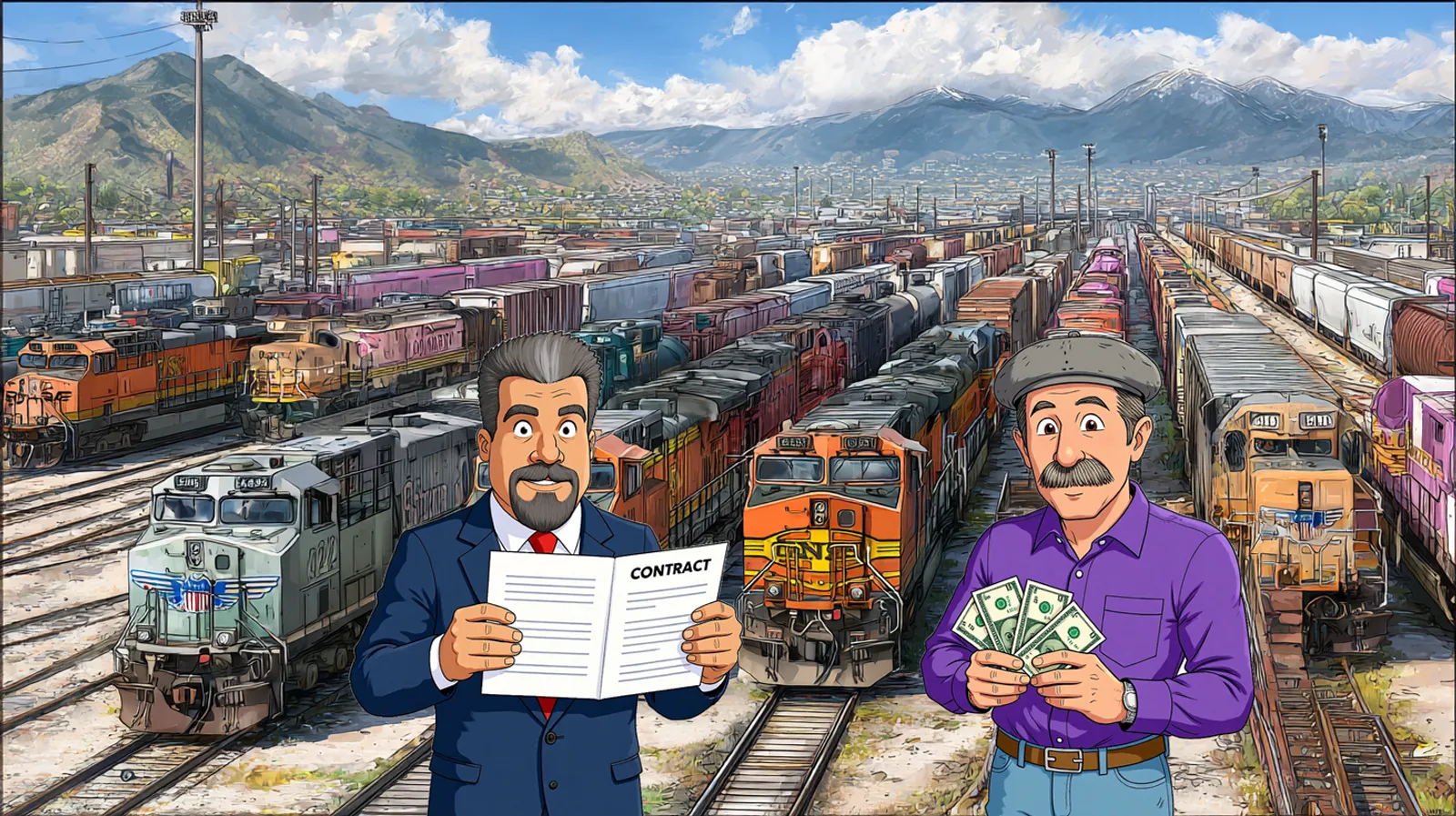
The era of the “Hostage Shipper” is not ending because of a sudden change of heart within the boardroom of the Class I railroads. It is ending because the Surface Transportation Board (STB) has successfully stripped away the veil of operational secrecy that has protected rail monopolies since 1985.
For forty years, the logistics industry operated under a regulatory regime—specifically the old Part 1144 rules—that required a shipper to prove a railroad was acting with “anticompetitive intent” before a reciprocal switch could be ordered. It was a nearly impossible standard, akin to proving a negative in a dark room. But the documents recently finalized and the subsequent regulatory pivot in January 2026 have replaced “intent” with “math.” By codifying objective performance standards and, more importantly, mandating the immediate release of individualized performance data, the STB has handed shippers a tactical blueprint for what can only be described as the “Shadow Audit.”
The Seven-Day Information Mandate
The structural foundation of this shift is found in 49 CFR § 1145.8, a provision that has received far less press than the 80% success rates or the 24-hour grace periods, yet carries significantly more weight for the modern transportation manager. The rule states:
“Within seven days of a written request from a shipper or receiver, the incumbent rail carrier shall provide that customer all relevant individualized performance records necessary to file a petition.”
This is the catalyst for the Shadow Audit. Historically, railroads controlled the narrative of their own performance. A shipper might feel that their service was deteriorating, but they lacked the granular, lane-specific data to prove it in a way that would stand up in front of the Board. Under the new mandate, the information monopoly is broken.A Shadow Audit is the systematic collection of this federally mandated data while a shipper is still ostensibly “locked” into a private rail transportation contract under 49 U.S.C. § 10709. While the Board generally cannot interfere with an active contract, it has explicitly opened the door to a question that should keep railroad general counsels awake at night: Can the Board use performance data collected during a contract to order a reciprocal switch that takes effect the moment that contract expires? By requesting this data under the auspices of § 1145.8, a shipper is not merely monitoring a vendor; they are building a legal “pre-mortem” for their next negotiation. If the data reveals a failure to meet the Service Reliability standard—where the ratio of on-time deliveries $A/B$ is less than 70%—the shipper is no longer begging for a better rate; they are holding a loaded regulatory gun.
The PSR Trap: Liability by Design
Perhaps the most aggressive shift in these documents is the STB’s direct assault on the labor and power models of Precision Scheduled Railroading (PSR). For years, railroads successfully defended service meltdowns by citing “unforeseen” crew shortages or locomotive scarcities.
Section 1145.3(a) of the new rules effectively classifies these “shortages” as a choice rather than a catastrophe:
“A carrier’s intentional reduction or maintenance of its workforce at a level that itself causes workforce shortage… would not, on its own, be considered a defense for failure to meet any performance standard.”
This is a profound reclassification of risk. The STB is asserting that if a railroad cuts its headcount to satisfy an operating ratio and subsequently fails to spot cars within the 12-hour window, that failure is “Strict Liability.” The railroad cannot point to a tight labor market or a sudden spike in sick calls if the underlying cause was an intentional lean-staffing model.
For the logistics professional, this means the “Affirmative Defense” wall has crumbled. When conducting an audit of a lane, the shipper no longer needs to debate why the railroad failed. If the failure occurred, and the railroad cannot prove a literal “Act of God” (like a bridge collapse or a flood), the failure is actionable.
Redefining the “Multimodal Handshake”
One of the deepest revelations in the STB’s 2023–2026 framework is the closing of the “Constructive Placement” loophole. In the legacy rail era, a railroad could claim a shipment was “delivered” the moment it reached a local yard, even if it sat there for days waiting for a local crew to “spot” it at the customer’s dock. This “ghost dwell” destroyed the ability of 3PLs to synchronize rail movements with autonomous trucking corridors or tight warehouse schedules.
The new definitions in § 1145.1 change the geometry of delivery:
“Constructive placement of a shipment at a local yard constitutes delivery only when… the recipient is unable to accept delivery at the designated destination.”
By resetting the clock to the moment the car is physically accessible at the shipper’s facility, the STB is forcing an unprecedented level of honesty into rail transit times. This aligns the rail “Time of Arrival” with the reality of the rest of the supply chain. If the railroad fails the Industry Spot and Pull (ISP) standard—failing to perform 80% of requested switches within the planned 12-hour window over 12 weeks—the shipper can now seek a switch to a competitor who can actually meet the handshake requirements of a modern, multimodal network.
The “Nuclear Option” of January 2026
The most significant “dot” to connect is the relationship between the Part 1145 performance standards and the January 2026 repeal of the Part 1144 “Competitive Access” rules.
For decades, Part 1144 acted as a shield for railroads, requiring shippers to clear an “unrealistically high bar” of proving anticompetitive conduct. By repealing these 1985 rules, the STB has signaled that it is no longer interested in debating the “public interest” in abstract terms. Instead, it has moved toward a “Competition as a Right” model.
The deeper implication is this: The 2023 performance standards were the “testing ground.” They established the math. The 2026 repeal of the 1985 rules is the “execution.” The Board has essentially decided that if a railroad cannot meet the basic service levels defined in the Shadow Audit—OETA reliability, transit time consistency, and ISP accuracy—they no longer deserve the monopoly protection of their tracks.
Strategic Conclusion for Shippers
The value for the logistics professional in 2026 is not in the ability to file a lawsuit; it is in the ability to command the data. The “Shadow Audit” is a defensive posture that prepares for an offensive move.
Demand Individualized Records: Utilize § 1145.8 to request your lane-specific data every 12 weeks. Even if you have no intention of filing a petition today, you are creating a “regulatory paper trail” that the railroad cannot dispute later.
Monitor the 12-Hour Window: Do not accept “Constructive Placement” as a metric for your own internal KPIs. Hold the carrier to the federal definition of “Actual Placement.”
Prepare for Contract Expiration: Use the 24-week look-back period defined in § 1145.7 to determine if the railroad is “terminally” incapable of meeting standards. If they are, you have the evidence required to move to a reciprocal switch the moment your private contract sunsets.
The STB has provided the tools to dismantle the captive rail model. The only question remains whether shippers are willing to do the heavy analytical lifting required to use them. The documents are clear: the era of “trust us, we’re trying” is over. It has been replaced by the era of “show us the data, or lose the freight.”