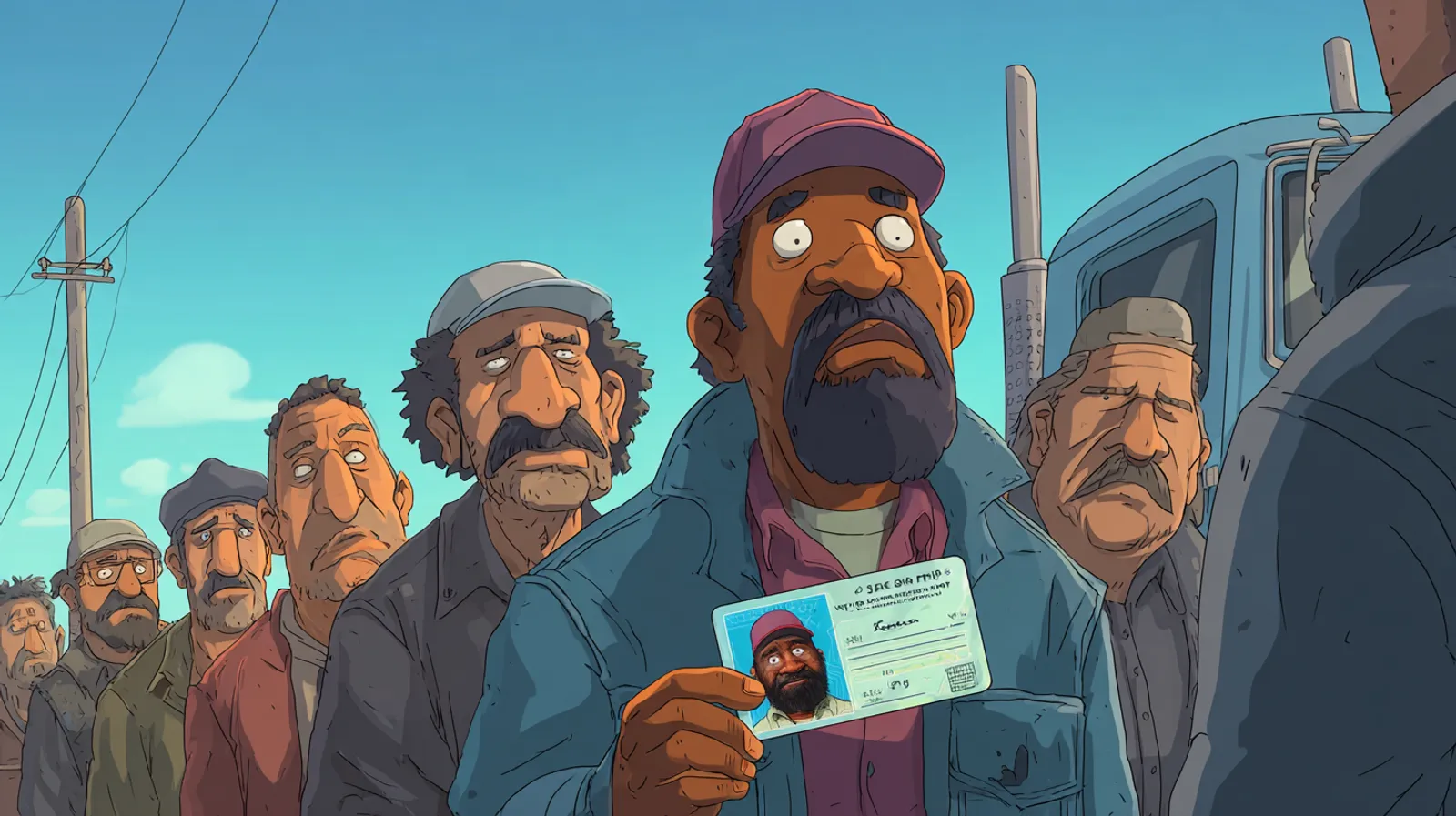
The logistics industry has always been a game of trust. We trust that the carrier who accepted the load is who they say they are. We trust that the driver at the gate matches the paperwork. But in 2026, trust has become a dangerous commodity.
Recent data from the National Insurance Crime Board, NCIB, reveals a staggering reality: fraud attempts in the logistics sector have surged to approximately $35 billion per annum in 2025. As global economic pressures fluctuate, the sophistication of criminal syndicates has scaled in tandem. We are no longer defending against “opportunity thieves”; we are facing sophisticated, organized entities armed with generative AI and stolen data from the dark web.
For logistics brokers and 3PLs, the question is no longer if you will be targeted, but whether your “gate” is a physical barrier or a digital sieve.
The Anatomy of the Modern Heist: A Case Study
To understand the vulnerability, look at a recent incident involving a major produce distributor in the Northeast.
Imagine a typical Tuesday at a 700,000-square-foot facility. A driver pulls up in a late-model rig. He presents a California Commercial Driver’s License (CDL). It looks perfect—the holograms catch the light, the microprinting is visible to the naked eye, and the driver is calm. Under a traditional manual check, this driver is waved through. He loads $200,000 worth of premium cargo and disappears.
Six hours later, the actual carrier calls to ask why the load was canceled.
The “Invisible” Red Flags:
In this scenario, a manual check failed because it couldn’t see what lies beneath the surface. Modern fake IDs are often printed on high-end Teslin or polycarbonate materials. However, a forensic scan would have revealed that while the “look” was right, the 100+ security features required by the State of California—including specific Ultraviolet (UV) and Infrared (IR) patterns—were either missing or incorrectly mapped.
Furthermore, the driver was likely using a synthetic identity: a “Frankenstein” ID that combines real, stolen data (SSNs from the dark web) with a fake face. Without “Liveness” checks and biometric matching, the gate guard is just a spectator to a crime in progress.
Why the Threat Landscape Has Exploded
We are currently seeing a “perfect storm” of three factors:
The AI Arms Race: Generative AI now allows fraudsters to create near-perfect replicas of government documents. They can even simulate “aged” licenses to bypass seniority requirements.
Economic Inverse Proportion: As the COO of identity firm IDScan recently noted at Manifest, there is an inverse relationship between economic stability and cargo crime. When the economy tightens, the ROI for sophisticated theft increases.
The Data Glut: With billions of records leaked over the last decade, criminals have the “ingredients” to create thousands of unique, verifiable-looking personas.
Beyond the Barcode: What “Identity Infrastructure” Actually Means
For a 3PL or broker, “scanning an ID” is no longer about data entry; it is about forensic authentication. The industry is moving toward “Identity Infrastructure”—a layered defense that treats every driver arrival as a multi-point data challenge.
The Five Benchmarks of Forensic Verification
| Feature | Manual/Legacy Check | Modern Forensic Verification |
|---|---|---|
| Verification Speed | 2–5 Minutes (High Error) | <10 Seconds (High Accuracy) |
| Document Depth | Visual/Surface check | 75–150 forensic checks (UV, IR, OCR, external databases) |
| Biometrics | Visual comparison (subjective) | 1:1 Face Matching with "Liveness" |
| Data Integrity | Manual typing (errors) | Automated parsing into TMS/WMS |
| Historical Guardrails | None | Global "Banned" and "VIP" watchlists |
-
Forensic Document Analysis High-end hardware now checks for light-reactive ink and patterns that are invisible to the human eye. In some states, digital codes are embedded within driver license numbers. Modern systems catch these discrepancies instantly.
-
Biometric Liveness Criminals have been known to carry dozens of different licenses. Facial recognition ensures that the person standing at the gate is the same person on the ID, preventing the “revolving door” of aliases.
-
Deterrence as a Strategy One of the most profound outcomes of implementing high-tech scanning is the “turnaround effect.” Warehouse managers report that when fraudulent drivers see professional scanning hardware at the gate, they often affect a hasty retreat. In fact , one leading vendor reported that some of their customers experienced a 30% reduction in cargo theft within the first few months of implementing advanced ID verification solutions.. The presence of the technology acts as a digital “No Trespassing” sign.
Mitigation Strategies for Brokers and 3PLs
If you are a shipping manager or a broker, your exposure is highest during the “handoff.” To mitigate risk, your SOPs should evolve beyond the basics:
Eliminate Manual Data Entry: Every time a guard or clerk types in a name, you lose accuracy and create a window for fraud. Use automated parsing to feed your TMS.
Verify the CDL, Not Just the ID: Ensure your system is checking for endorsements and expiration dates. A “valid” ID that expired yesterday is a common tactic used by unqualified drivers to test your security.
Audit Your “Ghost” Drivers: Frequently review your visitor logs. Are the same IDs showing up for different carriers? Is a driver with a Florida license consistently picking up loads in Washington state for a carrier based in Texas?
The Bottom Line
In the 2026 logistics landscape, a 3PL’s reputation is only as strong as its last delivery. Cargo theft doesn’t just cost money; it costs contracts and customer trust. By moving away from “checking IDs” and toward “authenticating identity,” we can close the gap that fraudsters have been exploiting for years.
The tools are no longer just for logistics entities. Financial Services, Healthcare, Government, Retail and other industry use cases are creating great demand for this type of solution. They are the new standard for the American supply chain.
Help Inform the Industry
The battle against cargo theft is not one that can be won in isolation. While advanced technology provides the shield, the industry’s collective experience provides the strategy. We recognize that the “Identity Crisis” we face in 2026 requires a shift in how we communicate across the supply chain. To that end, the Logistics Roundtable is bridging the gap between technical solutions and boots-on-the-ground reality.
We invite you to contribute to this evolving narrative. Whether your team has refined a specific handoff SOP that successfully flagged a “ghost driver,” or you have experienced a theft attempt so sophisticated it forced a total overhaul of your security protocols, your insights are the frontline intelligence your peers need.
Sharing these “war stories” and tactical successes doesn’t just build awareness; it hardens the entire industry against criminal syndicates. If you are interested in a deeper dive into the common misconceptions that hold companies back from adopting forensic tools, or if you have a specific question about the ROI of identity infrastructure, join the dialogue through our official social channels. Your expertise is the key to keeping the national supply chain moving safely and securely.